

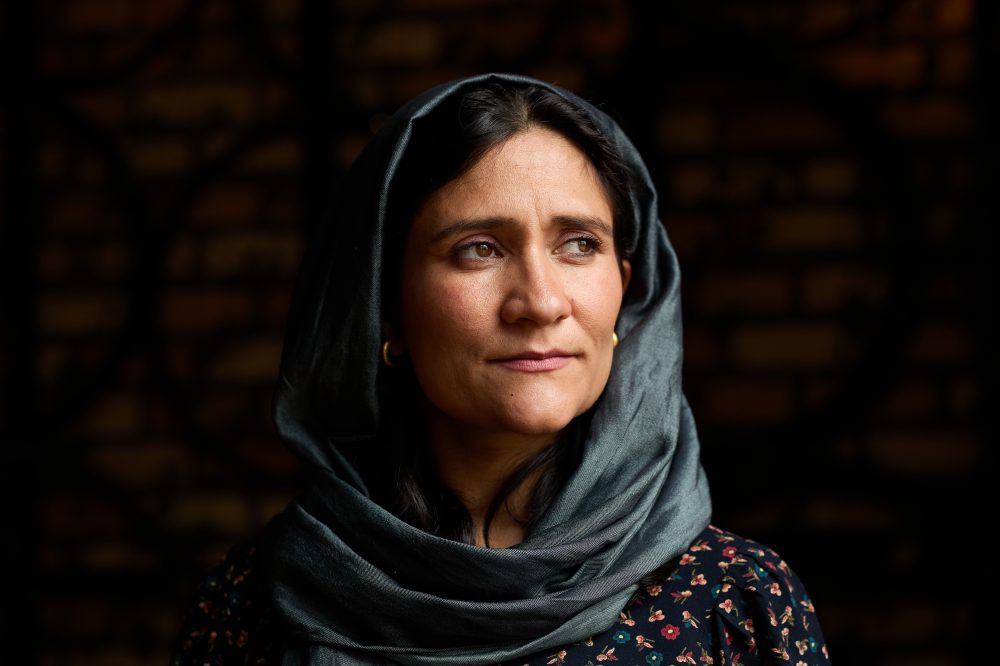
Shabana Basij-Rasikh smiles as she points to the sign in the middle of campus: School of Leadership of Afghanistan, SOLA, a home in Rwanda.
The sign, like the campus, is virtually brand new – with classes beginning for the first time later this month. It is a declaration, but also a symbol of the danger associated with educating Afghan girls – even thousands of miles from their homes. It’s not visible from outside the compound, whose location SOLA closely guards for safety reasons. It’s only for the students and faculty to see.
“That’s exactly what this place represents for us – a permanent home for our girls,” Basij-Rasikh explains. “I’m so grateful for the welcome that we have received.”
It has been five years since U.S. troops left Afghanistan and the Taliban once again took control of the country and its government. When Kabul fell, Basij-Rasikh fled Afghanistan for the East African nation of Rwanda, which had extended the school an encouraging invitation to relocate there. All the girls then enrolled at SOLA; about 100 recent graduates and the school’s faculty also joined her.
Four days after the group of 250 arrived in Rwanda, SOLA resumed classes at a hotel that became its temporary school.
“One of the things that really deeply inspires all of us is that these girls – they will never give up,” Basij-Rasikh said. “It’s just not part of their vocabulary or thinking.”
According to a United Nations report in August, about 2.4 million Afghan girls are excluded from secondary education in Afghanistan, and conditions for all Afghan women and girls have continued to deteriorate.
Before the Taliban took over Afghanistan, it stated girls would have access to education, employment and public participation, as long as it was in accordance with its interpretation of Islamic principles. But in 2021, the Taliban barred girls from attending school beyond the sixth grade — restrictions that remain in place today.
In August, a Taliban spokesperson said that Afghanistan pays “significant attention” to education, with more than 10 million students – about 25% of the nation’s population – currently enrolled in schools, universities, and institutes. The Taliban has said it is working to establish conditions under which girls and women can attend classes in line with Islamic Sharia laws.
The 122 girls enrolled at SOLA celebrate their opportunity to learn while mourning that girls and women back home are denied the same chance and face “very different futures,” including child marriage, Basij-Rasikh said.
What has long haunted SOLA’s faculty since it opened as a girls’ boarding school in Kabul in 2016 is the number of potential students it has had to turn away.
Thousands of Afghan girls from around the world annually apply to become SOLA students. However, even though the new Rwanda campus will allow SOLA to double enrollment, more than 99% of applications will still be rejected.
To reach more Afghan girls, SOLA created an online education platform that allows students to learn at their own pace using a smartphone. Basij-Rasikh and her husband, Mati Amin, developed SOLAx, which offers online classes based on the Afghan school curriculum for grades 6 through 12 via WhatsApp.
“We understood the political and technological realities on the ground,” said Amin, who has also launched several educational technology companies. “We knew we had to innovate in the space.”
Most Afghan girls don’t have their own smartphones, he said. Many borrow them from their fathers and brothers. They also lack reliable internet access and long stretches of uninterrupted time because of household chores. But they do find time to communicate with friends and family on WhatsApp.
That’s what made the app the right fit for SOLAx. The platform is available to anyone, but geared toward Afghan girls and includes built-in precautions that allow students to quickly delete their chats and resume studies where they left off using a PIN code, Amin said. The lessons for earlier grades, including English as a second language, are taught in Afghanistan’s official languages, Dari and Pashto, but later grades are taught in English.
SOLAx launched in 2024 and now has 41,000 students, mostly living in Afghanistan, but also in 76 other countries.
Student records are stored on SOLAx, in part because Basij-Rasikh is still troubled by having to burn all of SOLA’s records before she fled Afghanistan so the Taliban would not learn which families had educated their girls.
“I carry that fire and the flames of that with me to this day,” she said. “I remember feeling so much anger… And it felt like one of the moments where you have no idea the kind of fire you have started. This fire is going to come around and burn you one day.”
SOLAx, like all programs offered by the nonprofit SOLA, is free of charge and funded by donors from around the world.
Dame Louise Richardson, who headed the University of Oxford when Basij-Rasikh was earning a master’s degree in public policy there, said Basij-Rasikh’s dedication to educating Afghan girls was impressive even then.
Richardson, now president of the Andrew Carnegie Foundation, said Basij-Rasikh’s commitment to education mirrors that of the philanthropist who established the foundation. “The young women who are leaving their family, their country and everything they know, to travel to Rwanda for an education are paying a high price for their education,” Richardson said. “I believe they are truly worthy of our support.”
Haven Ley, chief strategy officer at Pivotal Ventures, said Basij-Rasikh’s 2016 launch of SOLA in Afghanistan put her on philanthropist Melinda French Gates’ radar. The two shared an “understanding of the role that girls’ education plays in empowering women.”
When French Gates launched an initiative in 2024 giving 12 leaders $20 million each to grant to charities doing urgent, impactful work supporting women and girls, she selected Basij-Rasikh as one of them.
Basij-Rasikh said she has directed the money to other Afghan civil society organizations, most of which are working in exile like hers. “The reality is that we can’t do this work alone,” she said. “We need a robust ecosystem of organizations that could address different aspects of the need in Afghanistan when it comes to girls and women, because it is enormous.”
These organizations, including SOLA, are not “waiting passively” to return to Afghanistan, Basij-Rasikh said.
“We have a mission to get ourselves back into Afghanistan,” she said. “The Afghan girls that we prepare in exile, they will be the ones who lead.”
With the opening of the school in Rwanda, Basij-Rasikh said she feels closer to her goal of solidifying that SOLA’s future is bigger than her. She says she still takes security precautions because when she was in Afghanistan, she learned that the Taliban wanted to kill her. However, those threats do not worry her now.
“We are ready,” she said. “We’re ready to be better known than we are. We’re ready to get this message out to the world, and to Afghan families and to Afghan girls. We are here. And we will always be here.”
_____
Associated Press coverage of philanthropy and nonprofits receives support through the AP’s collaboration with The Conversation US, with funding from Lilly Endowment Inc. The AP is solely responsible for this content. For all of AP’s philanthropy coverage, visit https://apnews.com/hub/philanthropy.
Brought to you by www.srnnews.com